Resources
May 9, 2026
The Complete Guide to Generative AI and Agentic Workflows
Mastering the Shift: From Foundational LLMs to Autonomous Agentic AI Systems
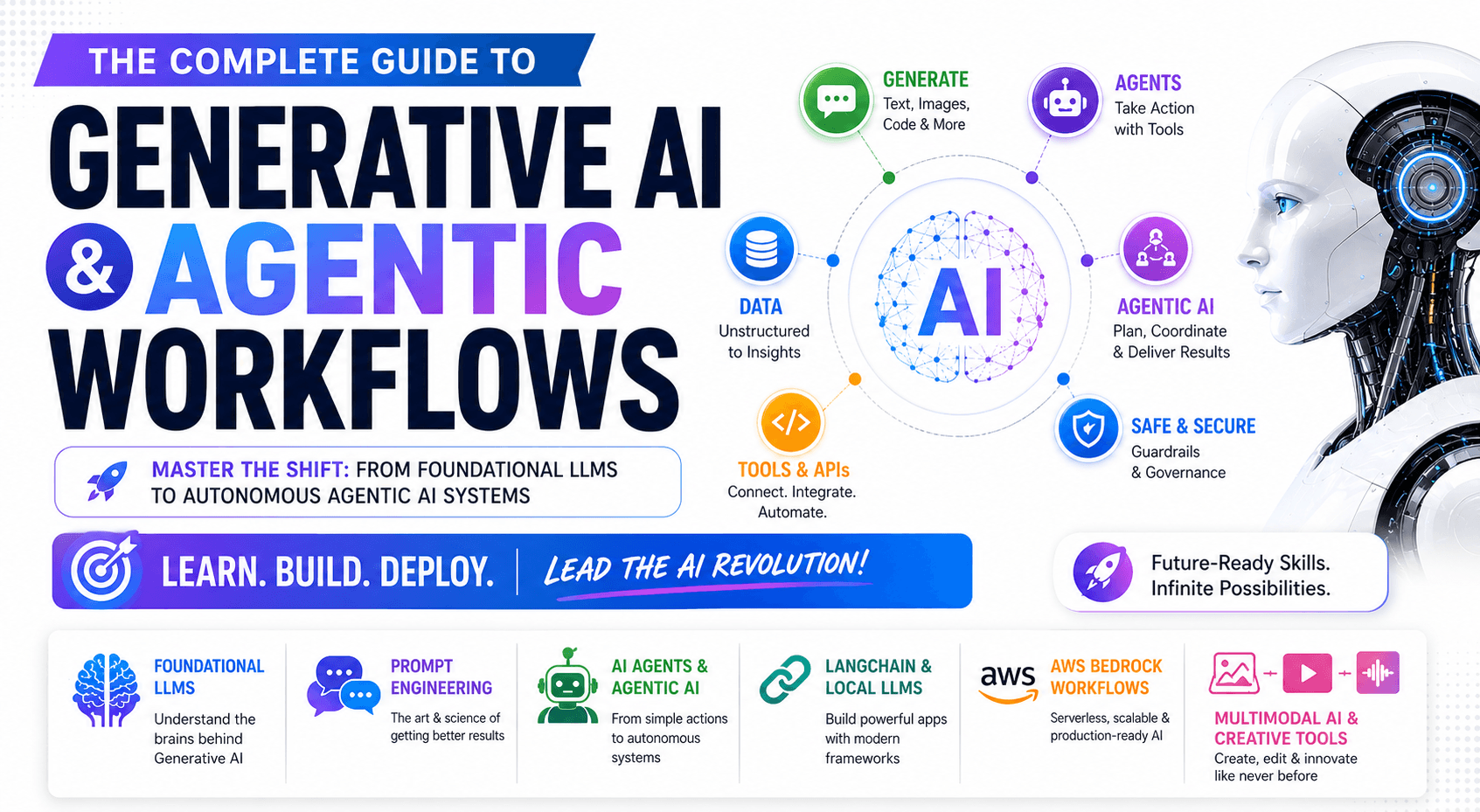
Generative AI represents a profound paradigm shift in technology, moving beyond simple instruction-following to the creation of original content. Unlike traditional AI, which focuses on classifying or predicting labels, Generative AI learns patterns from massive datasets to produce unique text, images, and code. This transition is not just technical but strategic; job postings for these skills have grown nearly 200 times in just four years.
To understand this landscape, we must look at the foundations of Large Language Models (LLMs). These "brains" of the generative system utilize the Transformer Architecture—introduced by Google in 2017—relying on Self-Attention to focus on critical information within a sequence. By breaking text into numerical Tokens, models can calculate the statistical likelihood of the next word, effectively acting as a "superpowered autocomplete."
Generative AI vs. Traditional ML
Feature | Traditional ML (Discriminative AI) | Generative AI (LLMs) |
|---|---|---|
Logic | Rigid If-This-Then-That | Probabilistic, Reasoning-based |
Data | Structured spreadsheets | Unstructured data (voice, images) |
Output | Binary Yes/No | Contextual Summarization |
Maintenance | High maintenance | Adaptable to text variations |
Harnessing this power requires the art and science of Prompt Engineering. By crafting specific instructions that include context, task, persona, and format, users can guide AI toward creative and accurate outputs. Techniques like Few-Shot Prompting and Chain of Thought (CoT)—asking the model to "think step by step"—reduce errors in complex reasoning and make the model's decision-making transparent.
We are now witnessing an evolution from simple chatbots to autonomous Agentic AI. While standard Generative AI creates content, AI Agents connect to external tools and APIs to take actions, such as booking flights. The highest level, Agentic AI, acts as a "team manager," coordinating multiple agents and using long-term memory to manage complex, multi-step goals through a Planner Module.
This progression is best visualized as a ladder of autonomy: Generative AI provides responses using LLMs; AI Agents add tools to take specific actions; and Agentic AI manages entire workflows by combining LLMs, multiple agents, and advanced planning. Building these systems is made possible by frameworks like LangChain, which serves as a "glue layer" connecting models to business logic, and AWS Bedrock, which provides managed access to foundation models for serverless workflows.
The Ladder of AI Autonomy
Level of Autonomy | Core Function | Key Components |
|---|---|---|
Generative AI | Provides responses | Large Language Models (LLMs) |
AI Agents | Takes specific actions | LLMs + External Tools/APIs |
Agentic AI | Manages entire workflows | LLMs + Multiple Agents + Planning Module |
The horizon of AI is expanding into Multimodal capabilities, where systems process text, images, and audio simultaneously. This innovation is fueling creative tools like Google Nano Banana for 3D modeling and Google Flow for cinematic video generation. Even data analytics is becoming conversational; instead of writing SQL, users can ask questions in plain English to build visualizations on demand via tools like Zapier or Make.com.
As we look forward, models like OpenAI 01 are shifting the focus from simple prediction to deep reasoning. These "Reasoning Engines" use invisible "mental sticky notes" to organize logic before answering. However, with this autonomy comes the necessity for Responsible AI frameworks to mitigate hallucinations and bias, ensuring that performance is measured not just by speed, but by accuracy and precision.
Embracing the Era of Collaborative Intelligence
The key to thriving in this era is agility. As technology moves toward multimodal capabilities and deep reasoning, the focus shifts from human effort to collaborative intelligence. In this new landscape, machines co-create and automate routine tasks, augmenting human potential and freeing us to focus on strategy and high-level innovation.
Ready to take your automation journey to the next level? Follow dnyanix.com for more resources, insights, and tools on AI and automation.
Credit: Content derived from the video Generative AI Full Course 2026 - Free Gen AI